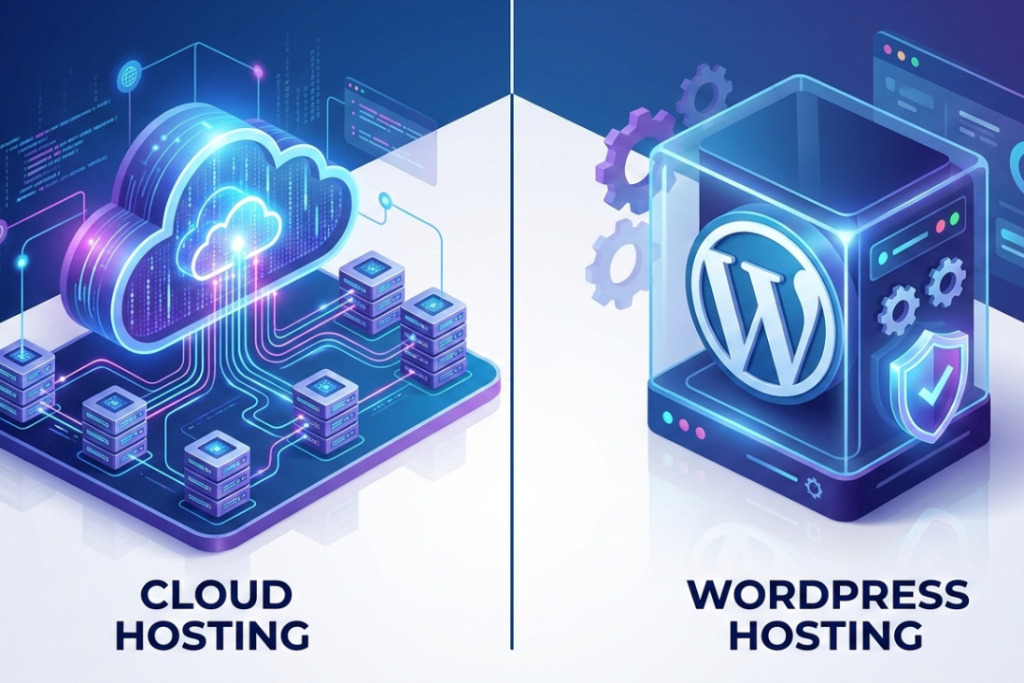
Cloud hosting vs web hosting can be confusing when you’re just getting started. Your website is hosted online but it works in a different way.
The hosting you choose affects your website speed, reliability , growth and cost. A lot of website owners begin with one type of hosting and change it later as their site grows. This guide explains cloud hosting and web hosting in simple words to help you choose what’s best for your site.
What Is Web Hosting?
Web hosting is the traditional way to host a website. Your site’s files are stored on one server in a data center. When someone visits your site, the server sends the website content to their screen.
There are different types of web hosting depending on the speed, control and help your website needs.
Common Types of Web Hosting

Shared Hosting
Your website shares a server with other sites. It’s affordable and easy to handle, so many beginners and small websites choose it.
VPS Hosting
A virtual private server gives your website a dedicated share of a server’s resources. It offers better speed and more control compared to shared hosting.
Dedicated Hosting
Your website uses an entire server on its own. This option is suitable for large websites that need high performance and strong security.
Managed Hosting
Managed hosting means the provider handles updates, maintenance and security, you can focus on your website content.
What Is Cloud Hosting?

Cloud hosting is different from traditional hosting, your website runs on multiple connected servers instead.
If one server faces an issue, another server in the network automatically takes over. This makes cloud hosting more flexible, reliable , especially for websites that expect more traffic.
Cloud Hosting vs Web Hosting:
Both options allow you to:
- Publish a website on the internet
- Support small and large websites
- Access security features and customer support
The main difference is in how server resources are provided and managed.
Differences Between Cloud Hosting and Web Hosting
Server Structure
- Web hosting relies on one physical server
- Cloud hosting uses multiple servers working together
Scalability
- Web hosting requires manual upgrades as your site grows
- Cloud hosting can quickly adjust resources based on demand
Speed and Uptime
- Web hosting performance depends on a single machine
- Cloud hosting distributes the workload, helping reduce downtime
Pricing
- Web hosting usually follows fixed monthly plans
- Cloud hosting often charges based on resource usage

Management
- Web hosting management depends on the selected plan
- Cloud hosting is commonly managed by the provider
Cloud Hosting vs Web Hosting Comparison
| Feature | Web Hosting | Cloud Hosting |
| Server type | Single server | Multiple servers |
| Scalability | Limited | Highly flexible |
| Performance | Reliable for steady traffic | Strong during traffic spikes |
| Pricing | Fixed monthly cost | Pay-as-you-use |
| Best for | Small to medium websites | Growing or variable-traffic sites |
Which Hosting Is Right for You?
Choose Web Hosting If:
- You run a small or medium website
- Your traffic remains consistent
- You prefer predictable monthly costs
- You are new to website hosting
Choose Cloud Hosting If:
- Your traffic changes frequently
- You expect your website to grow
- You need high uptime and flexibility
- You want easy scalability
When Should You Change Hosting?
You may need to switch hosting if:
- Your website starts loading slowly
- Visitor traffic has increased
- You need more control or flexibility
- Your current plan no longer meets your needs
Future of Hosting:
Cloud hosting is becoming more popular because it’s scalable and uses resources efficiently. Many hosting providers use energy efficient servers and smarter systems to make hosting faster and better for the environment.
Final Thoughts
Cloud hosting and web hosting are reliable solutions but they serve different purposes. Web hosting is good for small sites with steady traffic. Cloud hosting is better for sites that need flexibility and growth.
The best choice depends on what your website requirements and long term goals.
FAQs
Is cloud hosting better than web hosting?
Not always. The best option depends on your website’s size and traffic need.
Is cloud hosting expensive?
Cloud hosting can be cost effective but pricing varies based on usage.
Can I move from web hosting to cloud hosting later?
Yes, most hosting providers offer migration support.
Which hosting is easiest for beginners?
Web hosting is simple and beginner friendly.