Billions of files get uploaded to the cloud every single day. Photos, contracts, medical records, business data — all of it. And most people doing the uploading have never once asked the question: once my data is up there, who does it actually belong to?
It is a fair question. And the answer might surprise you.
What the Cloud Actually Is
People throw the word “cloud” around like it explains something. It does not. When your file gets uploaded to Google Drive or Dropbox, it does not float around in digital air. It lands on a physical server — a real machine sitting inside a warehouse somewhere, owned and operated by a company you probably never deal with directly.
Amazon, Microsoft and Google run the biggest cloud networks in the world. AWS alone has over 1.3 million servers. Microsoft Azure serves roughly one in five cloud users globally. These are enormous operations and your holiday photos and work spreadsheets are sitting somewhere inside them right now.
So the cloud is not a place. It is someone else’s computer. That distinction matters a lot when we start talking about ownership.
It Depends on What Type of Cloud Service You Use
This is where most articles get vague. The truth is, who owns your data depends on the kind of cloud service you signed up for.
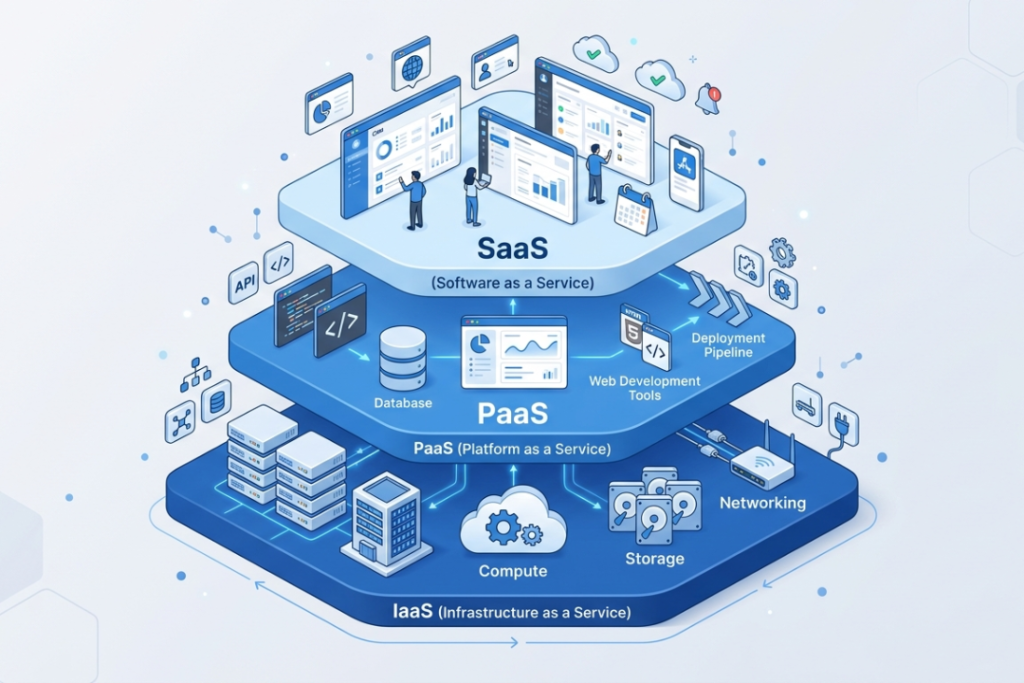
- With IaaS (Infrastructure as a Service), you rent the hardware — the servers, the storage, the networking — but your data stays yours. AWS is the most well-known example. What comes in and out is completely up to you.
- With PaaS (Platform as a Service), things get murkier. You are building or running an application on someone else’s platform. The data you create is generally yours, but the provider controls the environment around it. Read the contract carefully with these.
- With SaaS (Software as a Service), you are using someone else’s software — Gmail, Salesforce, Dropbox. You technically own your data, but the provider has a lot of say in how it is stored, processed and sometimes even accessed.
| Cloud Type | Your Data Ownership | Provider’s Role |
| IaaS | Full | Manages hardware only |
| PaaS | Partial | Manages platform and hardware |
| SaaS | Limited control | Manages everything |
What the Terms of Service Are Really Saying
Almost nobody reads the terms of service. That is a problem.
Cloud providers are legally required to spell out what they can and cannot do with your data. Most of them say you keep ownership of your files. Your photos are yours. Your documents are yours. But buried in the fine print, most providers also give themselves the right to process, analyze and back up your data as part of running their service.
There is another thing worth knowing. If a government or law enforcement agency sends a valid legal request, your cloud provider can hand over your data. In the United States, the CLOUD Act even allows American authorities to request data stored outside the US, as long as the provider is a US-based company.
This does not happen often. But it happens.
The Laws That Give You Rights Over Your Data
Different parts of the world have different rules about who controls your data and what companies can do with it.

- GDPR covers anyone in the European Union. It gives you the right to see your data, fix incorrect information and ask for it to be permanently deleted. Companies that break GDPR rules have paid fines as high as 10 million euros.
- CCPA is California’s version of similar protections. It lets residents ask companies what data they have collected and request that it be removed.
- HIPAA is specific to health information in the United States. It sets strict limits on how medical data can be stored or shared in any cloud environment.
If your data crosses international borders — which it often does without you knowing — the laws of the country where the server sits may also apply to your information.
Risks That Come With Cloud Storage
Using the cloud is convenient. It is also not without risk.
Data breaches are the most obvious one. Hackers target cloud systems regularly and when they get in, they can access huge amounts of personal and business data at once. The average cost of a breach in the US has hit $9.48 million.
Vendor lock-in is a quieter risk. If all your data lives inside one provider’s system, switching to another service can be painful — and sometimes your data does not transfer cleanly.
Data loss is also possible if a provider shuts down, suffers a major outage, or makes a technical error. And for businesses, compliance violations — storing regulated data in the wrong location or the wrong way — can lead to serious fines.
Simple Ways to Protect Your Data
You are not powerless here. A few habits go a long way.
Use multi-factor authentication on every cloud account. It is one of the simplest things you can do and one of the most effective. Encrypt files that contain sensitive information before you upload them — that way even if someone accesses your storage, they cannot read what is inside. Store only what you genuinely need in the cloud and delete what you do not.

Most importantly, know your rights. Under GDPR and CCPA, you can request a full copy of your data or ask for it to be deleted. These are real, enforceable rights and most people never use them.
Conclusion
In most cases, you own the data you store in the cloud. But ownership on paper and control in practice are two different things. Cloud providers have real power over how your data is handled, stored and shared. It helps to know what you signed up for, keep your account protected and understand your privacy rights. Your data should stay under your control.
Frequently Asked Questions
Can a cloud provider sell my data?
Most companies do not sell your personal data but some may still use general user information. That is why reading the privacy policy is important.
What happens to my files when I delete my account?
Many providers delete account data later, not immediately. Some also keep backup copies for extra time.
Is my data stored in my own country?
Not always. Cloud companies often store data in different countries. Some providers let you choose where your data is kept.
Can the government access my cloud data?
Yes, if the law allows it. US companies, for example, can sometimes be ordered to provide data even when it is stored in another country.
What is data sovereignty?
It simply means your data follows the laws of the country where it is stored.
Do small businesses need to worry about this?
Yes. Small businesses store customer and payment data in the cloud every day. If something goes wrong, the business is responsible. Understanding ownership rules is not just for large companies.