Cloud computing has made it easy for businesses to run websites, apps and services from anywhere. But with this flexibility comes a big challenge: security. When data and applications move to the cloud, they also become a target for online attacks.
This is where cloud firewall security plays an important role.
A cloud firewall acts like a smart security guard that controls who can enter or leave your cloud environment. It helps protect your apps, networks and data from unwanted access and cyber threats.
What Is a Cloud Firewall?
A cloud firewall is a security system that protects cloud based applications and data by filtering network traffic. Instead of being installed as physical hardware, it runs in the cloud.

It checks incoming and outgoing traffic and decides whether to allow or block it based on security rules.
This cloud based model is often called Firewall-as-a-Service (FWaaS).
Simple example:
Imagine your website is hosted on a cloud server. A cloud firewall blocks suspicious visitors, stops hackers and allows only safe users to access your site.
How a Cloud Firewall Works
A cloud firewall works quietly in the background using a few basic steps:
- Traffic Check – It monitors all traffic trying to reach your cloud apps.
- Rule Matching – It compares traffic against security rules.
- Allow or Block – Safe traffic is allowed, risky traffic is blocked.
- Threat Detection – It looks for attacks like malware, bots or unusual activity.
- Central Control – Everything is managed from one dashboard.
This process helps keep your cloud environment secure at all times.
Cloud Firewall vs Traditional Firewall
Both firewalls aim to protect networks but they work very differently.
Traditional Firewall:
- Installed as physical hardware
- Limited to one location
- Hard to scale
- Needs manual updates
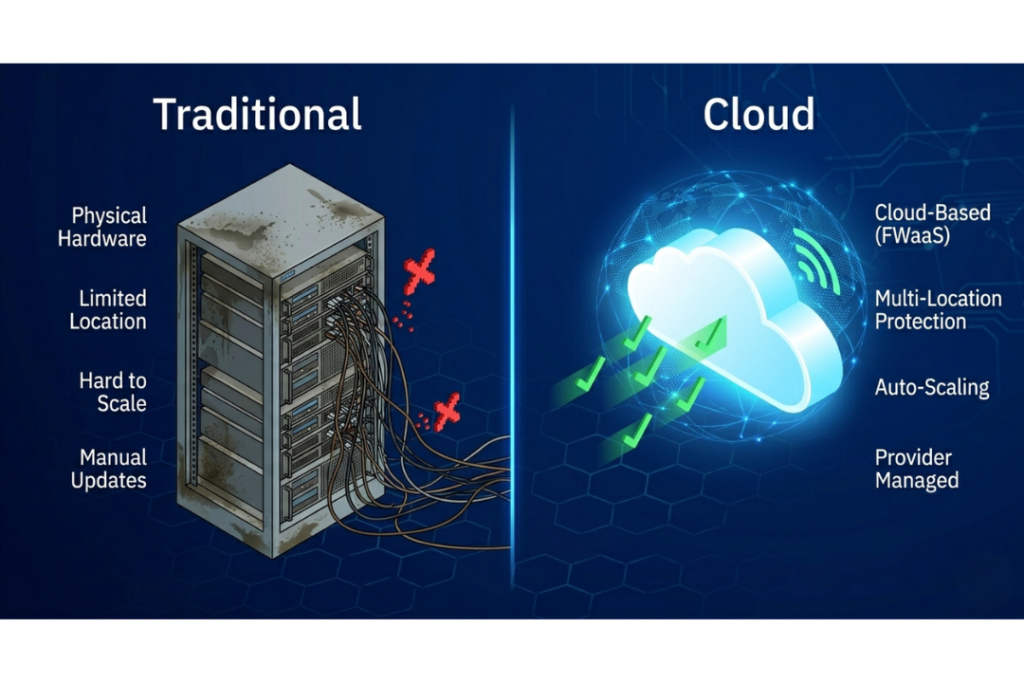
Cloud Firewall:
- Runs fully in the cloud
- Protects multiple locations
- Scales automatically
- Updates are handled by the provider
For modern cloud-based businesses, cloud firewalls are often the better choice.
Why Businesses Need Cloud Firewall Security
Businesses today rely heavily on cloud apps, remote work and online services. Traditional security tools are no longer enough.
Cloud firewall security helps by:
- Protecting cloud apps and websites
- Securing remote workers
- Stopping data leaks
- Supporting basic compliance needs
- Reducing security risks in cloud environments
Whether you run a small website or a large cloud platform , a cloud firewall adds an important layer of protection.
Key Benefits of Cloud Firewalls
Cloud firewalls offer several clear advantages:

- Stronger Security – Blocks malware, bots and unauthorized access
- Easy Scaling – Grows automatically with your traffic
- Cost-Effective – No hardware or maintenance costs
- Centralized Management – One control panel for everything
- Less Downtime – Always-on protection
These benefits make cloud firewalls ideal for modern businesses.
Types of Cloud Firewalls (Easy Explanation)
There are different types of cloud firewalls, each serving a specific purpose:
- Firewall as a Service
A complete firewall solution delivered through the cloud.
- Web Application Firewall
Safeguards websites and web apps against SQL injection and XSS attacks.
- Cloud Native or Virtual Firewalls
Built specifically for cloud platforms and virtual networks.
Most businesses use a combination of these for better security.
Cloud Firewall Use Cases
Cloud firewalls are used in many real world situations:

- Protecting websites and mobile apps
- Securing remote employees
- Managing hybrid and multi cloud setups
- Safely migrating data to the cloud
They help maintain security no matter where users or apps are located.
Challenges of Using Cloud Firewalls
Although cloud firewalls are powerful, they come with some challenges:
- Initial setup can be confusing
- Requires proper rule configuration
- Needs integration with other security tools
- Does not replace data encryption
With the right planning, these challenges can be handled smoothly.
Cloud Firewall Security Best Practices
To get the best results from a cloud firewall:
- Use clear and simple security rules
- Monitor traffic regularly
- Keep policies updated
- Combine firewall protection with other security tools
- Avoid overly complex configurations
Good practices improve security and reduce risks.
Cloud Firewall and Modern Security (FWaaS & SASE)
Cloud firewalls often work as part of modern security models like FWaaS and SASE.
These approaches focus on protecting users and data from anywhere, not just from one network location.
In simple terms, they bring security closer to users instead of relying on old network boundaries.
Key Takeaways:
- Cloud firewalls protect apps, networks and data
- They are flexible, scalable and cost effective
- Ideal for remote work and cloud environments
- Easy to manage from one place
- An essential part of modern cloud security
FAQs:
What is Firewall as a Service ?
FWaaS is a firewall service that runs in the cloud and provides security without needing any physical firewall devices.
Is a cloud firewall better than a traditional firewall?
For cloud environments, yes. It is more flexible and easier to scale.
Can small businesses use cloud firewalls?
Yes, cloud firewalls are affordable and suitable for small businesses.
Does a cloud firewall slow down traffic?
No, most cloud firewalls are designed to handle high traffic efficiently.
Is a cloud firewall enough for full security?
It is a key part of security but should be combined with other tools.